Watershed Restoration Areas
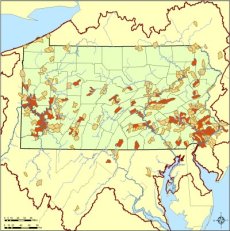
The goal of this portion of the study was to use data compiled in the ACC project to determine which watersheds are likely in the worst condition and therefore a priority for habitat restoration. To do so, we combined information from our Least-Disturbed Stream (LDS, Chapter 9) reach analysis, biological metric scoring (see WCP Page) and locations of biological communities indicative of poor-quality stream habitat (see community page). A multi-faceted approach such as this is more useful than a single-indicator approach, such as only examining developed land area in a watershed or determining the occurrence of pollution-tolerant taxa. By combining both biotic and abiotic features of the landscape we are able to highlight the watersheds where the functionality of biological assemblages is being altered by a variety of disturbances.
This analysis is meant to suggest which watersheds in the state may be in the greatest need of restoration activity. The water quality issues that are affecting these watersheds may differ significantly, therefore the measures necessary to improve water quality will vary as well. The watersheds listed as part of this "restoration" category should be used only to guide conservation efforts; on-the-ground site visits and knowledge of specific streams and watersheds will be needed to verify conditions that have been described here. The most common water quality problems in Pennsylvania are discussed in Chapter 11 of the ACC User's Manual.
For more information about these Watershed Restoration Priorities, the data used to select them, and a summary of common water quality issues in Pennsylvania, see Chapter 11 of the ACC User's Manual.